Nicmos Peels Away Layers of Dust to Show Inner Region of Dusty Nebula
On May 11 in 2002
Cone Nebula
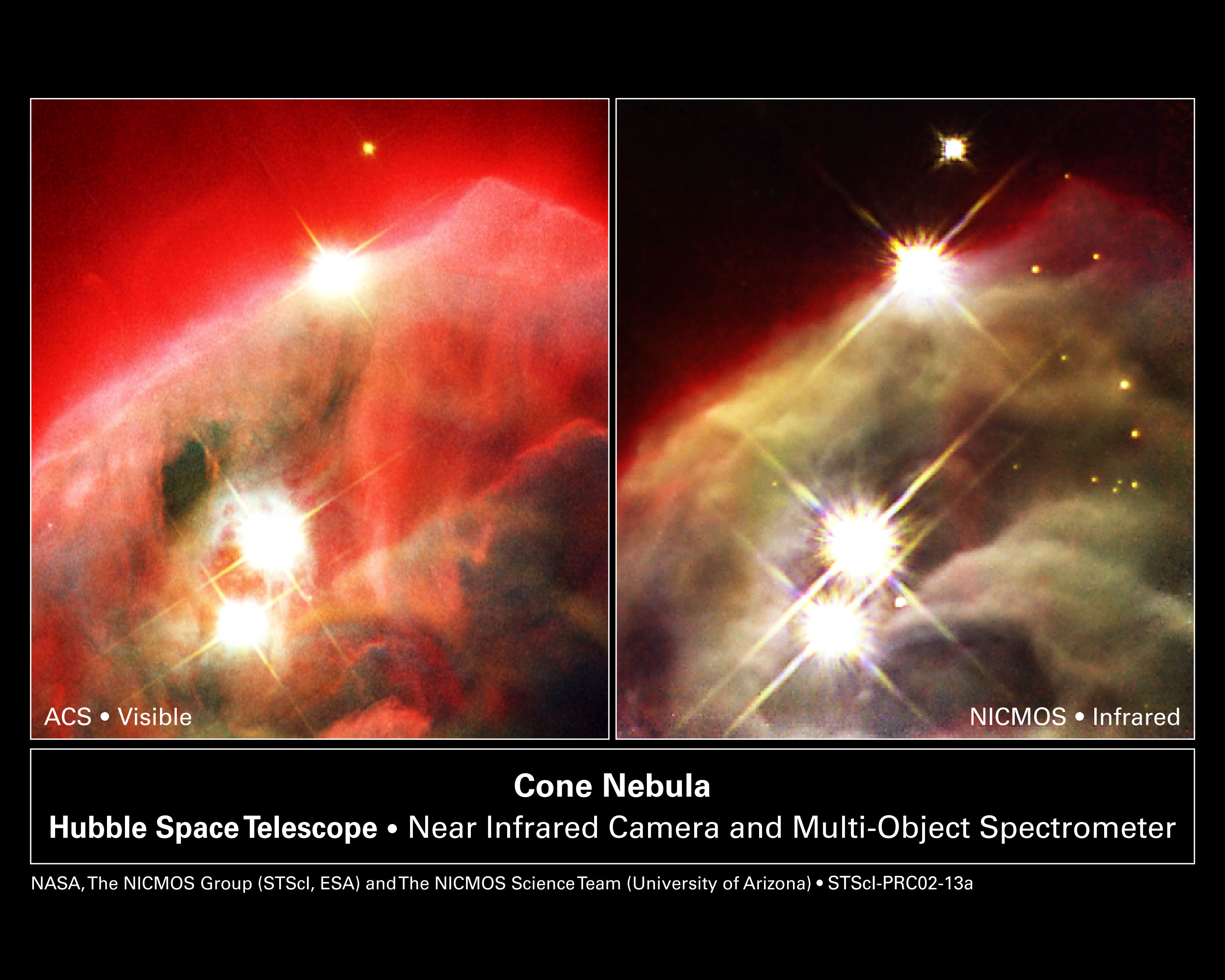
This image shows the tip of the Cone Nebula, a star-forming region in the constellation Monoceros. This conical pillar stretches over seven light-years and is just a small portion of a much larger star-formation complex.
The revived Near Infrared Camera and Multi-Object Spectrometer (NICMOS) aboard NASA's Hubble Space Telescope has penetrated layers of dust in a star-forming cloud to uncover a dense, craggy edifice of dust and gas [image at right].
This region is called the Cone Nebula (NGC 2264), so named because, in ground-based images, it has a conical shape. NICMOS enables the Hubble telescope to see in near-infrared wavelengths of light, so that it can penetrate the dust that obscures the nebula's inner regions. But the Cone is so dense that even the near-infared "eyes" of NICMOS can't penetrate all the way through it.
The image shows the upper 0.5 light-years of the nebula. The entire nebula is 7 light-years long. The Cone resides in a turbulent star-forming region, located 2,500 light-years away in the constellation Monoceros.
Radiation from hot, young stars [located beyond the top of the image] has slowly eroded the nebula over millions of years. Ultraviolet light heats the edges of the dark cloud, releasing gas into the relatively empty region of surrounding space.
NICMOS has peeled away the outer layers of dust to reveal even denser dust. The denser regions give the nebula a more three-dimensional structure than can be seen in the visible-light picture at left, taken by the Advanced Camera for Surveys aboard the Hubble telescope. In peering through the dusty façade to the nebula's inner regions, NICMOS has unmasked several stars [yellow dots at upper right]. Astronomers don't know whether these stars are behind the dusty nebula or embedded in it. The four bright stars lined up on the left are in front of the nebula.
The human eye cannot see infrared light, so colors have been assigned to correspond with near-infrared wavelengths. The blue light represents shorter near-infrared wavelengths and the red light corresponds to longer wavelengths.
The NICMOS color composite image was made by combining photographs taken in J-band, H-band, and Paschen-alpha filters. The NICMOS images were taken on May 11, 2002.
Nicmos Peels Away Layers of Dust to Show Inner Region of Dusty Nebula - NASA Science
The revived Near Infrared Camera and Multi-Object Spectrometer (NICMOS) aboard NASA's Hubble Space Telescope has penetrated layers of dust in a star-forming cloud to uncover a dense, craggy edifice of dust and gas [image at right]. This region is called th
science.nasa.gov
'🌌 NASA > 🚀5월, 6월' 카테고리의 다른 글
| [NASA] 5월 15일 - Red Spots on Jupiter (0) | 2026.05.15 |
|---|---|
| [NASA] 5월 14일 - Galaxy Cluster Abell 2744 (0) | 2026.05.14 |
| [NASA] 5월 13일 - IRAS 19297-0406 (0) | 2026.05.13 |
| [NASA] 5월 12일 - Star-Forming Region N11B (0) | 2026.05.12 |
| [NASA] 5월 10일 - Red Spots on Jupiter (0) | 2026.05.10 |
| [NASA] 5월 9일 - Red Spots on Jupiter (0) | 2026.05.09 |
| [NASA] 5월 8일 - Comet ISON (0) | 2026.05.08 |
| [NASA] 5월 7일 - Galaxy NGC 3982 (0) | 2026.05.07 |


